
The tyre date code and the 10-year rule for lorries
The age of a tyre is in the last four digits of the DOT marking on its sidewall: the week, then the year. 1826 means week 18 of 2026. Since 1 February 2021, a tyre aged 10 years or more is illegal on the front steered axle of a lorry, bus or coach in Great Britain, and on every single wheel of a minibus.
Reading the date code
Find the letters DOT on the sidewall. After them comes a string of letters and numbers that identifies the factory and the tyre; the date is the four digits at the very end, often in a small oval of its own. One of our V-PRO S2 steer tyres, for example, carries:
DOT 1TB DCBB5K 1826
| Date code | Made in |
|---|---|
| 1826 | week 18 of 2026 |
| 4725 | week 47 of 2025 |
| 0116 | week 1 of 2016: 10 years old in January 2026 |
Three things to know before you read one:
- One side only. The date code has to be on one sidewall, not both. On a twin wheel it may face inwards, against the other tyre.
- Three digits means before 2000. Tyres made before 2000 carry a three-digit code (week, then the last digit of the year). Any of those is far past 10 years.
- Retreads have two dates. A retreaded tyre can show the date of the casing and the date of the retread. The retread date is the one that counts for age.
The 10-year rule, position by position
The rule came in through an amendment to the Construction and Use Regulations. The DVSA set out how it is enforced:
| Where the tyre is | Aged 10 years or more | Date code not legible |
|---|---|---|
| Front steered axle of a lorry, bus or coach | Dangerous fail at the annual test; immediate prohibition at a roadside check | Fail at the annual test; delayed prohibition at a roadside check |
| Single wheels of a minibus (9 to 16 passenger seats) | Same as the front axle | Same as the front axle |
| Other axles of lorries and buses, and trailers over 3.5 tonnes | Not banned | Minor fail at the annual test (the certificate is still issued); inspection notice at a roadside check |
The DVSA's HGV inspection manual counts as front steered axles those ahead of the middle of the chassis and turned by the steering system, so a twin-steer tractor has two.
Trailers and drive axles
There is no age ban on trailer tyres or on the rear axles of a lorry. When the government decided the rule in 2020, it kept the ban to the front axle because it found too little evidence to support an all-axle ban. That is not a free pass: the DVSA expects operators to record the age of tyres over 10 years old on other axles and to make a risk assessment for each, taking in the distance, speed and load the vehicle runs at.
Age starts at the factory, not at fitting
A tyre that sat in a warehouse for three years is three years old on the day you fit it. For a steer tyre that will run for several years, buy recent stock and check the code before it goes on.
Every tyre we sell has its date code on record against its own 10-digit barcode, and older stock goes out first, so nothing sits on the shelf. On 26 November 2026 our yard held 388 tyres: 368 made in 2026, 19 in 2025 and 1 in 2024. Ask and we read the code off the tyres you are buying before they leave.
Sources
- Ban on tyres over 10 years old for heavy vehicles and some minibuses, DVSA, 9 December 2020
- Government response to the consultation to ban tyres aged 10 years or older, Department for Transport, July 2020
- Heavy goods vehicle (HGV) inspection manual, DVSA, version of 1 April 2026
HGV tyre tread depth: the 1 mm legal minimum · See all five sizes and prices
Order by axle
Public price per tyre, ex VAT. Signed in to your account, the site shows your own prices.
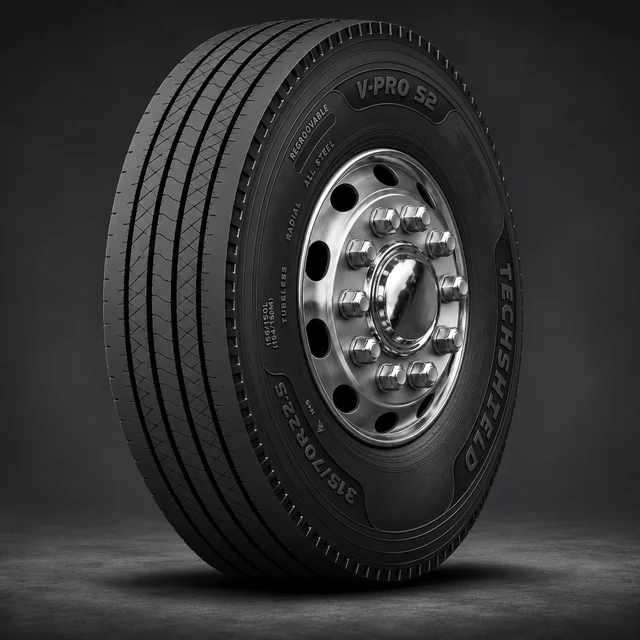 Steer315/70R22.5 V-PRO S2£205 ex VAT
- Steer315/80R22.5 V-PRO S2£210 ex VAT
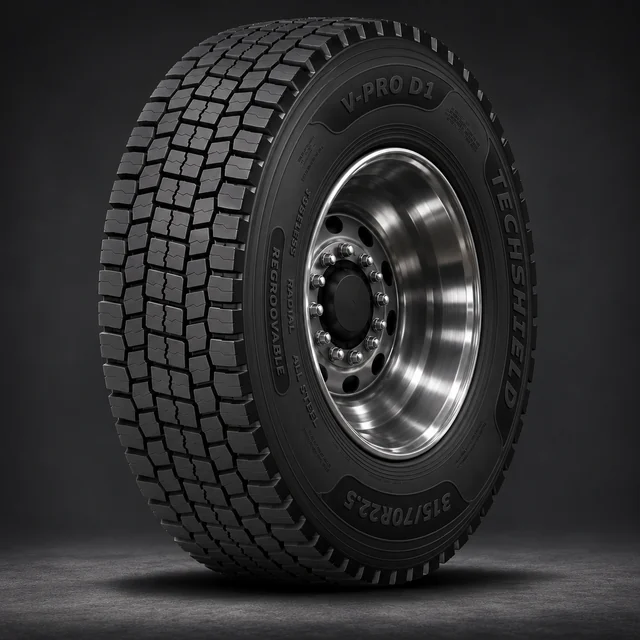 Drive315/70R22.5 V-PRO D1£205 ex VAT
- Drive315/80R22.5 V-PRO D1£210 ex VAT
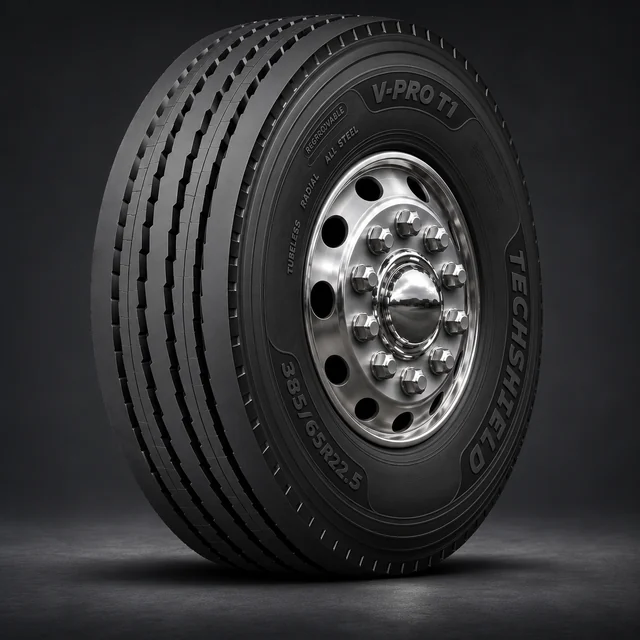 Trailer385/65R22.5 V-PRO T1£215 ex VAT