
HGV tyre tread depth: the 1 mm legal minimum, explained
On a lorry or trailer over 3,500 kg, the law in Great Britain asks for at least 1 mm of tread, in a continuous band across at least three-quarters of the tread's breadth, all the way round the tyre. Cars and vans need 1.6 mm. The rule is regulation 27 of the Road Vehicles (Construction and Use) Regulations 1986.
The minimum, by vehicle
| Vehicle | Minimum | Where on the tyre |
|---|---|---|
| Goods vehicles over 3,500 kg, and their trailers | 1 mm | a continuous band at least three-quarters of the tread breadth, round the whole tyre |
| Vans up to 3,500 kg, cars, light trailers | 1.6 mm | the central three-quarters of the tread, round the whole tyre |
Two details in the same regulation catch people out. The base of every groove in the original pattern must still be clearly visible, even outside the measured band. And if the original grooves never reached three-quarters of the breadth, every groove that was there must have 1 mm.
How it is checked at the MOT
The DVSA's HGV inspection manual (the version of 1 April 2026) takes the breadth of tread as the part of the tyre that touches the road in normal use, measured across the tyre. If a tread wear indicator is level with the tread around it, the tester measures the depth before deciding; the indicator alone does not fail the tyre.
To check your own: use a tread depth gauge in the main grooves, across the tyre and at several points round it, because tyres rarely wear evenly. Write the readings down at every inspection. Two readings a few weeks apart tell you how fast that axle is wearing and when the tyre will need changing.
What else fails a tyre
Regulation 27 lists other faults besides depth. A tyre is not legal if it has:
- a cut longer than 25 mm or 10% of the section width (whichever is greater) that reaches the ply or cord;
- a lump, bulge or tear from the structure separating or failing;
- any ply or cord showing;
- pressure that is not fit for the load and use;
- a type that is unsuitable for the use, or does not match the tyres on the other wheels.
The manual tells testers how to tell a bulge from a repair: a repair feels firm under the hand, a separation gives.
Regrooving
A heavy truck tyre marked REGROOVABLE on the sidewall has rubber under the grooves that can be cut deeper once, to win back some tread. The law allows it only in the maker's own recut pattern, and only if the cutting does not expose the ply or cord. Recut tyres may go only on motor vehicles of 2,540 kg unladen or more and trailers over 1,020 kg unladen.
Tyre age on the steer axle
Depth is not the only limit. Since February 2021, tyres aged 10 years or more are banned on the front steered axles of lorries in Great Britain. The age comes from the four-digit date code on the sidewall: week, then year, so 1826 is week 18 of 2026. The manual counts as front steered axles those ahead of the middle of the chassis and turned by the steering. More in the date code guide.
1 mm is the limit, not the target
At 1 mm the tyre stops being legal, so most operators set their own replacement point higher and change tyres at a planned inspection, not at the roadside. Shallower grooves also have less room to clear water. Where you set the point is your call; what matters is that every vehicle in the fleet uses the same one and the readings are on file.
How much tread our tyres start with
| Tyre | Axle | Tread when new |
|---|---|---|
| V-PRO S2 | Steer | 15 mm |
| V-PRO D1 | Drive | 21 mm |
| V-PRO T1 | Trailer | 15 mm |
One V-PRO D1 that we measured ourselves went from 21 mm to 5.75 mm in 171,000 km on a drive axle. That is one truck on its routes, not a promise for every truck, but it was read off the tyre with a gauge, not taken from a brochure.
Sources
- The Road Vehicles (Construction and Use) Regulations 1986, regulation 27, legislation.gov.uk
- Heavy goods vehicle (HGV) inspection manual, DVSA, version of 1 April 2026
Which tyre for which axle · See all five sizes and prices
Order by axle
Public price per tyre, ex VAT. Signed in to your account, the site shows your own prices.
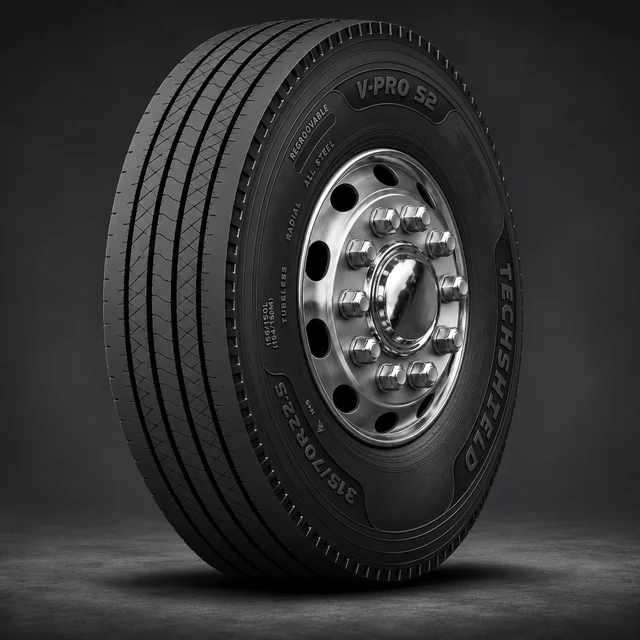 Steer315/70R22.5 V-PRO S2£205 ex VAT
- Steer315/80R22.5 V-PRO S2£210 ex VAT
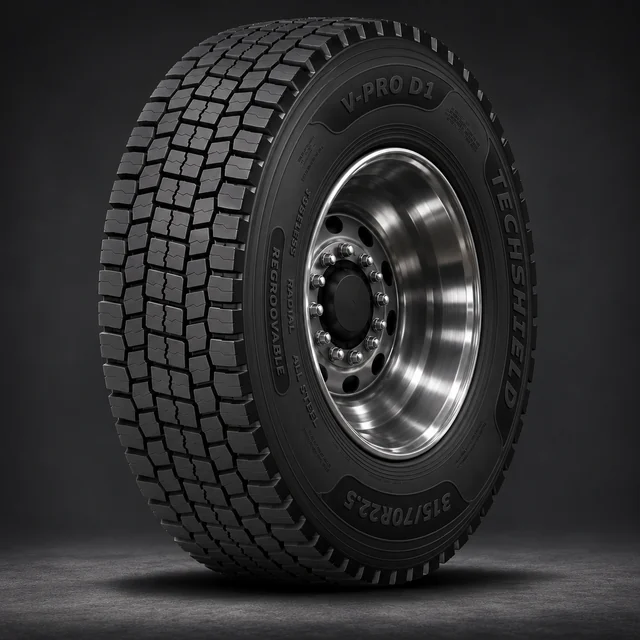 Drive315/70R22.5 V-PRO D1£205 ex VAT
- Drive315/80R22.5 V-PRO D1£210 ex VAT
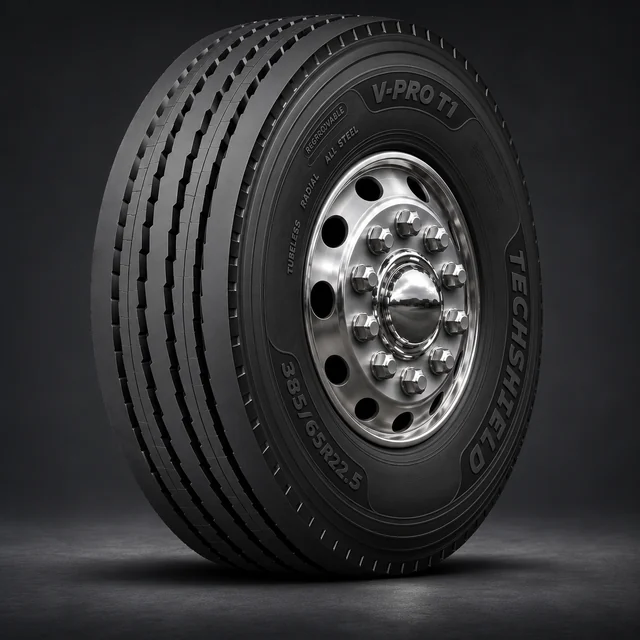 Trailer385/65R22.5 V-PRO T1£215 ex VAT