
HGV PMI and tyres: what a safety inspection checks
A PMI, the preventive maintenance or safety inspection, is the regular check an operator commits to on its operator licence. It has to cover at least everything the annual test covers, using the DVSA inspection manual, and the tyres are part of it on every visit. This guide sets out the rules for the tyres and gives you a sheet to fill in at the next one.
How often a PMI is due
There is no single legal interval. The DVSA's Guide to maintaining roadworthiness asks operators to set one from how fast their vehicles wear: their age and type, the maker's recommendations, the loads, the work, the terrain, and the distances and speeds. It "would normally range between 4 to 13 weeks", and whatever you choose is recorded against your licence, which commits you to it. The guide gives these examples:
| Type of operation | Example interval |
|---|---|
| Lightly loaded vehicles, easy operating conditions | 10 to 13 weeks |
| General haulage, trunking | 6 to 10 weeks |
| Arduous work, constant heavy loads | 4 to 6 weeks |
| Off road, difficult conditions | 4 weeks |
| Vehicle or trailer 12 years old or more | 6 weeks |
The records of every inspection are kept for at least 15 months, including for vehicles you have since sold or taken off the licence.
What a PMI checks on the tyres
The tyre checks come from the same source as the annual test: regulation 27 of the Construction and Use Regulations 1986 and the DVSA's HGV inspection manual. On each tyre:
- Tread depth: at least 1 mm in a continuous band across three-quarters of the tread and all the way round, with the base of every original groove still visible. More on tread depth.
- Damage: a cut longer than 25 mm or 10% of the section width that reaches the cords; any lump, bulge or tear from the structure failing; any ply or cord showing.
- Date code: legible, and the tyre under 10 years old on a front steered axle. More on the 10-year rule.
- Suitability: the right type for the vehicle's use and matching the tyres on the other wheels, with a load index that covers the axle. Check the load index.
- Pressure: fit for the load the vehicle carries.
On top of the legal checks, the DVSA guide's tyre management section expects these written on the inspection report: tread depths measured with an accurate gauge, pressures as found, any illegible date code, and a tyre at 9 years old as an advisory, so the operator can plan its replacement before it turns 10.
Tyre inspection sheet
Pick the vehicle, then type what you measure on each tyre. Each one is checked against the rules above as you type, and the whole sheet prints on one page for the vehicle file.
Date code: the last four digits of the DOT marking, for example 1826 for week 18 of 2026; type X if it cannot be read. The sheet works out the age from today's date. It helps you record and spot problems; it does not replace the inspection report or the inspector's judgement.
What the inspection report must record
The DVSA guide lists what a safety inspection record should hold at least:
- the operator's name
- the date (and ISO week) and the place of the inspection
- who carried it out
- the registration or trailer number, make and model
- the odometer reading, where there is one
- every item inspected, with its condition
- the defects found
- the inspector's name and signature
- the repairs made and who made them
- a signed, dated declaration that the defects are repaired and the vehicle is roadworthy
Brakes at every PMI
Not a tyre item, but on every safety inspection: the DVSA expects a brake performance assessment each time, by a roller brake test, an electronic braking performance monitoring system, or a decelerometer with temperature readings. It names a laden roller brake test on a calibrated tester as the most effective of the three.
Who does the inspection
The inspector has to be technically competent, trained in vehicle examination and reporting, and know the DVSA manuals. Experience alone can be enough, but the guide strongly recommends a recognised accreditation such as IRTEC.
Between inspections
A PMI every few weeks does not replace the driver's daily walkaround. The DVSA guide asks operators to add checks where damage is likely during the day, and drivers working on rough sites to walk round the vehicle before leaving, paying particular attention to the wheels and tyres.
When the PMI finds a tyre to change
We keep 315/70R22.5 and 315/80R22.5 steer and drive tyres and 385/65R22.5 trailer tyres at our yard in West Thurrock. Every tyre carries its own 10-digit code that follows it onto your invoice, and we will read you the date code of the tyres you are buying before they leave, which is what your tyre records need.
Sources
- Guide to maintaining roadworthiness, DVSA: sections 1.4, 1.5, 3.1, 4.2, 4.4, 4.7, 5.2 and 5.3
- Heavy goods vehicle (HGV) inspection manual, DVSA, version of 1 April 2026
- The Road Vehicles (Construction and Use) Regulations 1986, regulation 27, legislation.gov.uk
Tread depth · Date code and the 10-year rule · Load index calculator · See all five sizes and prices
Order by axle
Public price per tyre, ex VAT. Signed in to your account, the site shows your own prices.
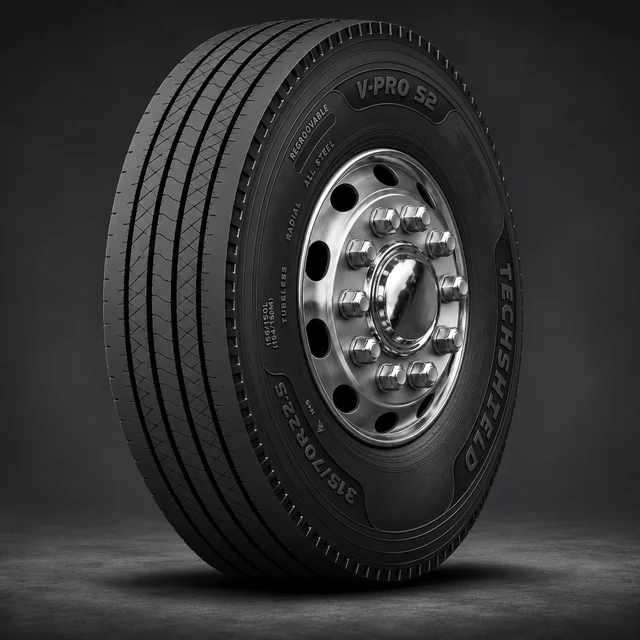 Steer315/70R22.5 V-PRO S2£205 ex VAT
- Steer315/80R22.5 V-PRO S2£210 ex VAT
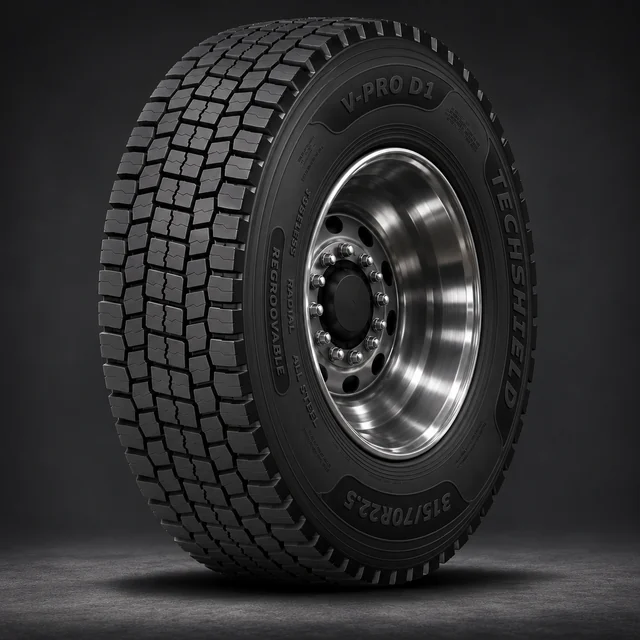 Drive315/70R22.5 V-PRO D1£205 ex VAT
- Drive315/80R22.5 V-PRO D1£210 ex VAT
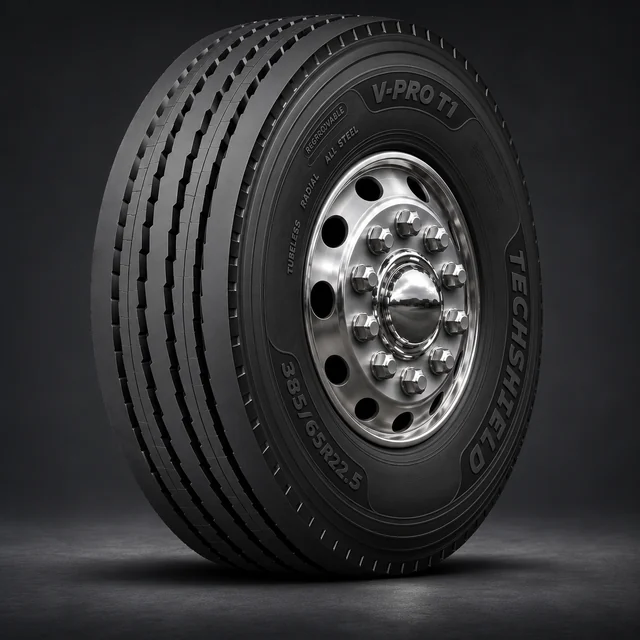 Trailer385/65R22.5 V-PRO T1£215 ex VAT